
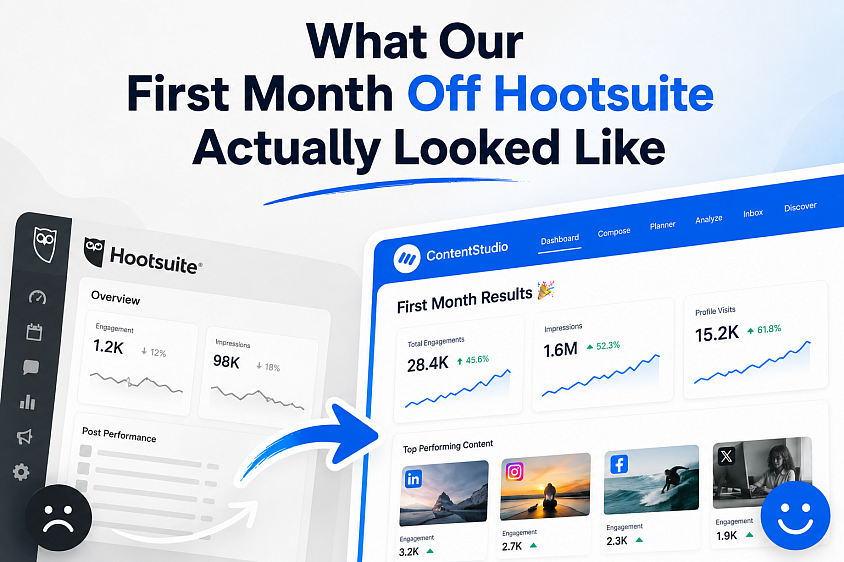
What Our First Month Off Hootsuite Actually Looked Like
I didn't plan the switch for January. It happened because I finally sat down with our annual software costs in December and did the one thing I'd been avoiding for longer than I'd like to admit: I added it all up.
Hootsuite. Three seats. Eight client accounts. The analytics add-on we'd convinced ourselves was essential six months ago when a client asked for a deeper reporting breakdown and we'd never actually revisited whether we still needed it. The number wasn't catastrophic. It wasn't the kind of line item that triggers an emergency budget meeting. But it was high enough that I spent the next hour looking seriously at what we were actually getting for it. The answer, when I wrote it down plainly, was: a scheduler, a basic reporting dashboard, and a long list of features we'd never once opened.
I'd seen the phrase "free alternative to Hootsuite" enough times in forums, Reddit threads, and marketing comparison articles that I'd started filtering it out the way you filter out banner ads. It sounded like the kind of SEO bait that leads you to a stripped-down tool with a catch buried deep in the pricing page: limited accounts, a post cap, watermarked reports, something. I clicked through anyway, mostly to rule it out so I could go back to my spreadsheet with a clear conscience.
I didn't rule it out.
By the first week of January we were in migration. By the end of the month I had a clear and honest picture of what the switch actually cost us: in time, in disruption, in learning curve, and in what we got back on the other side. Here's the full version, without the promotional framing.
Week One: Migration Was the Part I'd Been Dreading
I'd built up the migration in my head as a multi-week project. Something that would require a dedicated sprint, a checklist document, probably a few late evenings. It took four days. Not four days of focused, heads-down work, but four days of doing it in the gaps alongside everything else, the way you'd knock out any medium-sized admin task you'd been overthinking.
The account reconnections were the part I'd assumed would be painful. Eight client accounts, four platforms each: LinkedIn, Instagram, Facebook, X. We went through them workspace by workspace. No connections failed. The OAuth flow was identical to every other tool we'd used. The clients didn't notice anything was happening, which is exactly what you want during a backend migration.
The scheduled content queue was where I genuinely expected problems. We had roughly six weeks of content scheduled forward across all accounts: a mix of evergreen posts, campaign-specific content, and time-sensitive announcements tied to client events. I exported what I could from Hootsuite, reformatted the CSV to match the import spec, and uploaded. Most of it landed cleanly on the first pass. A small number of posts needed manual rescheduling. I'd estimate twenty posts total across all eight accounts. That's an afternoon of careful work, not a project. Not a reason to delay.
By Thursday of week one, all eight accounts were live, all active campaigns were running, and every member of the team was posting from the new platform. We hadn't lost a single scheduled post to a client. The migration I'd dreaded for months took less time than the quarterly reporting cycle I'd been putting off at the same time.
Week Two: The Workflow Felt Different Before I Could Explain Why
The second week was when the structural differences started to show up in ways I could feel but hadn't yet put into words.
On Hootsuite, our content production workflow ran across three tabs, minimum. Discovery happened in Feedly, which we paid for separately. Drafting happened in a shared Google Doc, or directly in ChatGPT, which required copying and pasting back and forth. Scheduling happened in Hootsuite. None of these tools talked to each other. We'd normalised the friction so thoroughly over two years that we'd genuinely stopped noticing it was friction. It was just how content production worked.
Having the AI drafting tools and the content discovery feed sitting inside the same screen as the scheduler changed that in a way that took me a few days to properly articulate to the team. What changed wasn't the individual steps; it was that the creative thread no longer broke between them. I'd find an article worth sharing, adapt the angle, draft a caption, generate platform-specific variations for LinkedIn versus Instagram, and schedule it, without switching tabs once. The thinking stayed continuous. The context didn't reset every time I moved to a different tool.
That might sound like a minor convenience. The time saving in week two was not minor. We moved from roughly four hours of content production per account per week to closer to two and a half. The accounts didn't change. The output didn't drop. The content quality, as far as we could measure it through engagement in that early period, held steady. The process simply got faster because the tool stopped requiring us to leave it every twenty minutes to go do something in another window.
Across eight accounts, that difference adds up fast. I'll come back to the numbers at the end of month one.
Week Three: The Team Stopped Asking Questions About Access
This was the change I hadn't anticipated at all, which is probably why it surprised me the most.
On Hootsuite, seat allocation was a regular low-level management task. Not a major burden in any single instance, but a persistent one: the kind of administrative overhead that never makes it onto a formal time audit but compounds quietly over months. Who needed access to which accounts. Who had approval permissions. Whether a new freelancer needed a temporary seat, and what adding that seat would do to the monthly billing tier. Whether it was worth the upgrade or whether they should just send drafts over Slack for someone else to schedule.
Those conversations happened constantly. Small, forgettable, individually meaningless. But they were always there.
By week three on the new platform, they had stopped. The workspace structure meant access was a functional decision rather than a financial one. I added a freelance writer mid-month who was covering two client accounts while our senior content manager was on leave. I gave her access to those two workspaces in about ninety seconds. No tier review. No billing change. No email to our finance contact asking whether it was okay to bump up seats for the rest of the month. She had access, she did the work, she was done. That was it.
For anyone managing a growing or fluctuating team, with freelancers cycling in and out, client accounts being onboarded and offboarded, and different team members needing different levels of access, this is not a small thing. The Hootsuite model of paying for headcount creates a friction layer around every team expansion, no matter how temporary. Removing that layer changes how you think about who you bring in and when.
Week Four: The Number I'd Been Waiting to See
End of January. First full billing cycle on the new platform.
The direct cost comparison, like-for-like seats, same account count, equivalent feature tier, came out meaningfully lower. Not marginal. Not a rounding error. Enough that I went back and checked our feature access twice to make sure we hadn't inadvertently downgraded something we were actually using. We hadn't. Everything was there.
The indirect saving was harder to attach a precise number to, but more significant in practice. Roughly six hours of content production time saved per week across the team. At any reasonable internal hourly rate, that figure is a larger number than the platform cost difference, and it recurs every single week. By the end of January, the total value recovered between the direct cost reduction and the time saving was not something I could attribute to a promotional pricing period or a honeymoon effect. It was structural.
We were not running a stripped-down setup. We had full AI drafting access, content discovery, per-network composer, client approval workflows, and analytics reporting. The lower cost wasn't a trade-off. It was just what the tool cost.
What I'd Tell Someone Who's in the Same Place I Was in December
The switch is less disruptive than you're assuming. If you're managing a multi-account setup and you've convinced yourself that migration is a quarter-long project requiring dedicated resources, it probably isn't. We did it in four days without dropping a single piece of scheduled content to any client. The mental weight of the migration was heavier than the migration itself.
The cost difference is real and it's structural, not promotional. It doesn't come from cutting features you actually use. It comes from a pricing model that isn't built around charging you for headcount, and from a feature set that's designed for how content teams actually work in 2025 rather than how they worked in 2019 when many of the incumbent tools were built.
The workflow improvement, the collapsed tab stack, the AI tools sitting adjacent to the scheduler, the discovery feed that doesn't require a separate subscription, all of that compounds over time. Month one gave us a clear data point. Month two confirmed it wasn't a honeymoon effect. The time we recovered in January didn't drift back. It stayed recovered.
If you're still on Hootsuite and you're in the same position I was in December, running the numbers and not loving what you see, ContentStudio is worth an honest trial. Not a cursory look where you poke around for twenty minutes and decide it feels different. An actual trial with your real accounts, your real content workflow, and your real team. The first month tells you everything you need to know, and the migration is far less painful than the dread you've built around it.
Who Should Stay on Hootsuite
This isn't a case where the answer is always to switch. There are situations where Hootsuite makes sense, and I'd rather be straightforward about them than oversell the alternative.
If you're a solo operator with a small, stable account set and no plans to grow, Hootsuite's reliability, browser extension ecosystem, and brand recognition are real and worth something. The product works. The interface is familiar to a lot of clients and collaborators. For a simple scheduling operation with no team complexity and no need to scale, the per-seat cost is effectively invisible and the familiarity has genuine value. There's no reason to migrate for its own sake.
But if you're managing multiple accounts with a team of any size, bringing in freelancers, onboarding new clients, producing significant volumes of content each week, or trying to build a content operation that can grow without the software costs growing proportionally, the gap between what you need and what Hootsuite gives you in 2025 is worth examining seriously before you renew. You might find, as I did, that you've been paying a premium for a workflow that was creating friction you'd simply learned to live with.
The December audit that started all of this took me an hour. The migration took four days. The time we've recovered since then is something we're not giving back.
https://merry-hardy.federatedjournals.com/the-analytics-view-that-finally-proved-our-social-roi/
https://portfolium.com/entry/managing-every-dm-and-comment-from-one-inbox
https://app.thebrain.com/brain/a7ba5b8d-1b60-4504-bd8e-019aed215b6c
https://webanketa.com/forms/6mw3cc1n6mqk2r9mcmt6ae9n/